
Proactive threat hunting
Log analysis and behavioural baselines help analysts search for deviations beyond existing alerts.

XCITIUM / Xcitium XDR
Connect endpoint, network and cloud telemetry. Give security teams the context to investigate incidents and move into response within one workflow.
INSIDE THE TECHNOLOGY
XDR correlates events from supported sources to reveal relationships that isolated alerts can miss. Available sources and integrations depend on the solution configuration.

Telemetry from endpoints, network and cloud sources creates a shared investigation context.
Connected telemetryIndicators of compromise, file reputation and behavioural evidence help identify related activity.
Incident contextTimelines, Windows event logs, registry, web history and file-system artefacts help reconstruct the attack sequence.
Evidence-led investigationIsolate endpoints from the network, block activity, collect additional evidence and use live response commands.
Isolate · block · remediateFOR THE SECURITY TEAM
Log analysis and behavioural baselines help analysts search for deviations beyond existing alerts.
File-system metadata, event logs and registry evidence help assess the sequence and impact of attacker activity.
Xcitium Complete XDR adds the vendor’s SOC expertise. Service scope, integrations and escalation arrangements are agreed for each Azerbaijan deployment.
MEET THE PLATFORM
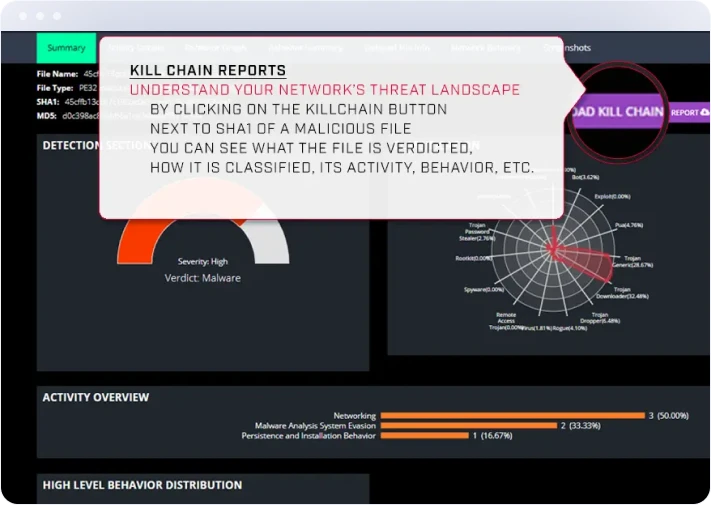
The Kill Chain report brings together file classification, activity and behavioural evidence to inform the next investigation step.
Xcitium product referenceCapabilities
Complete XDR SOC analysts investigate security events and provide response guidance.
Notifications about attacker activity, malware and suspicious behaviour help analysts prioritize investigations.
Automated forensic collection and attack timelines help reconstruct an incident. Coverage of $MFT, Windows Event Logs, Registry and Web History artefacts depends on the selected plan and configuration.
Blocking, endpoint isolation, custom commands and Live Response support incident response. Complete XDR adds SOC investigation and guidance.
Compare approaches
| Consideration | Xcitium XDR platform | Xcitium Complete XDR service |
|---|---|---|
| Primary role | Provides detection, correlation, and response tools across supported sources. | Adds SOC analyst investigations and operational guidance. |
| Main input | Endpoint, network, and cloud telemetry; source coverage depends on configuration. | Platform notifications and incidents for investigation. |
| Response and investigation | Configured capabilities such as isolation, blocking, forensic collection, and live response. | SOC investigation, threat hunting, and post-incident guidance. |
| Responsibility boundary | The customer configures sources, integrations, policies, and platform operations. | Service scope, hours, escalation, and approval are defined by agreement. |
Before you start
Validate telemetry, notifications, and response permissions for a limited source set. For Complete XDR, agree on analyst scope, service hours, escalation and actions requiring approval.
Which endpoint, network, and cloud sources, integrations, and licenses are in scope?
Which threat notifications are high priority, who receives them, and how are they escalated?
What customer approval is required for blocking, device isolation, and live response commands?
How does the agreement define Complete XDR service hours, SOC investigation scope, and responsibilities?
Before you decide
The platform correlates endpoint, network and cloud telemetry, provides notifications and investigation context, and supports configured response actions.
Complete XDR adds SOC analyst investigations, threat hunting and post-incident guidance. Service scope is defined by agreement.
Capabilities include notifications about attacker activity, malware and suspicious behaviour, forensic collection and attack timelines. Artefact coverage depends on licensing and configuration.
Blocking, device isolation, custom commands and Live Response follow configured rules. Response policies define automatic steps and actions requiring customer approval.
Xcitium
Define integrations, pilot scope and an implementation plan for Azerbaijan.